
Review of the 2025-2026 Burrowing Owl Winter Season

Following the extraordinary Burrowing Owl winter season last year, we experienced a very good winter season this year. We had early arrivals, late departures, and periods when park visitors could see three owls in a short walk. In addition to the owls that took up residence for extended periods, we had a number of owls passing through. Hundreds of park visitors had the experience of seeing one or more of our owls. People traveled to the park especially to see them. Many local visitors had seen signs about the owls but didn’t believe they were real until they saw one. People spread thousands of snapshots and videos over social networks. Berkeley became known as a host city for these lovable endangered and charismatic birds.
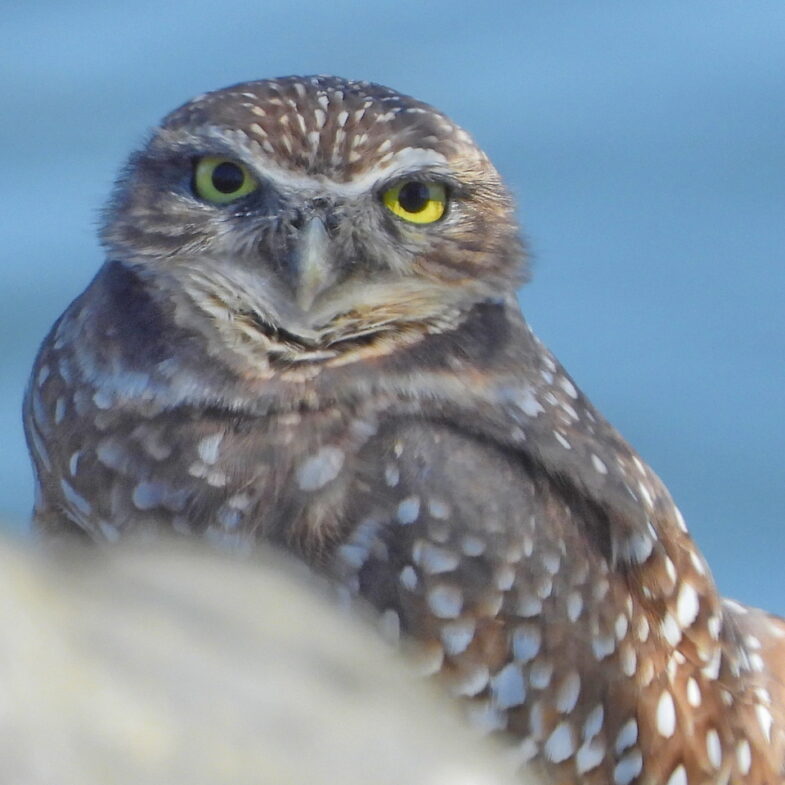
Veteran owl spotter Mary Law saw the first owl on Oct 5 at Perch B. That bird stayed three days; it was last seen Oct 8. On Nov 4 I saw what was possibly the same owl near Perch B. A different owl was seen and photographed once at Perch B on Feb 16.
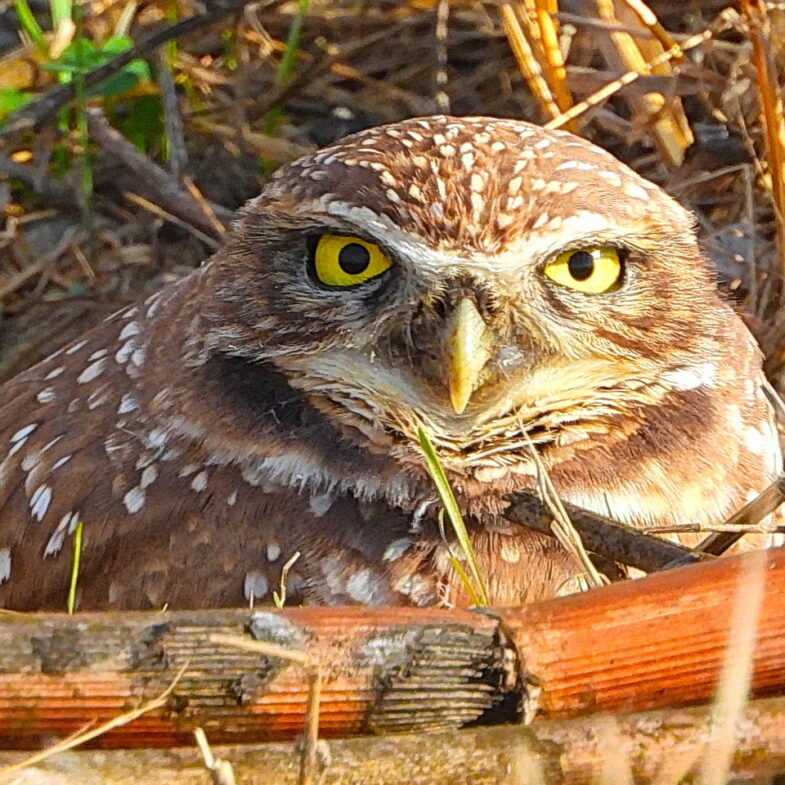
On Oct 21, Virginia Browning, Daniel Borgstrom, Carolyn S., and Shizuko McLarty each spotted a second owl at Perch F, a highly exposed spot. The owl stayed there four days; it was last seen Oct 25. Feleciana Feller saw an owl in that spot on Nov 10 and again on Nov 18. No owls were seen in that spot for the rest of the season.
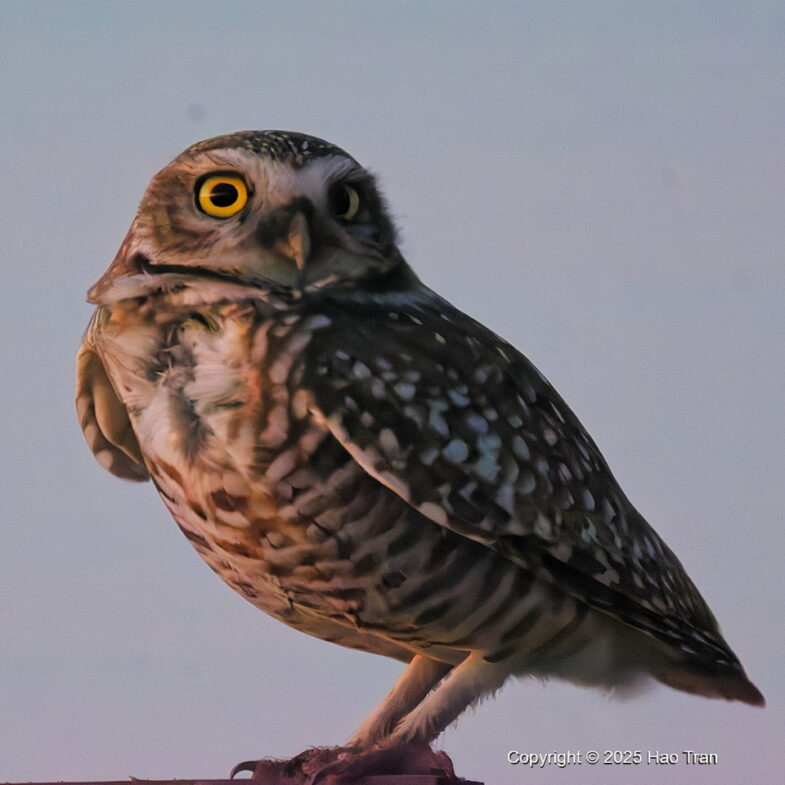
Photographer Hao Tran spotted a third owl near Perch G on the north edge of the owl sanctuary on Nov 1. Mary Law and Virginia Browning saw an owl in that area on Nov 14. Melissa Schneider spotted an owl peeking over the edge of the paved trail at Perch G on Dec 5. There was no way to tell whether these three north-edge sightings were the same owl. They may have been early sightings of what later became known as the North Owl.
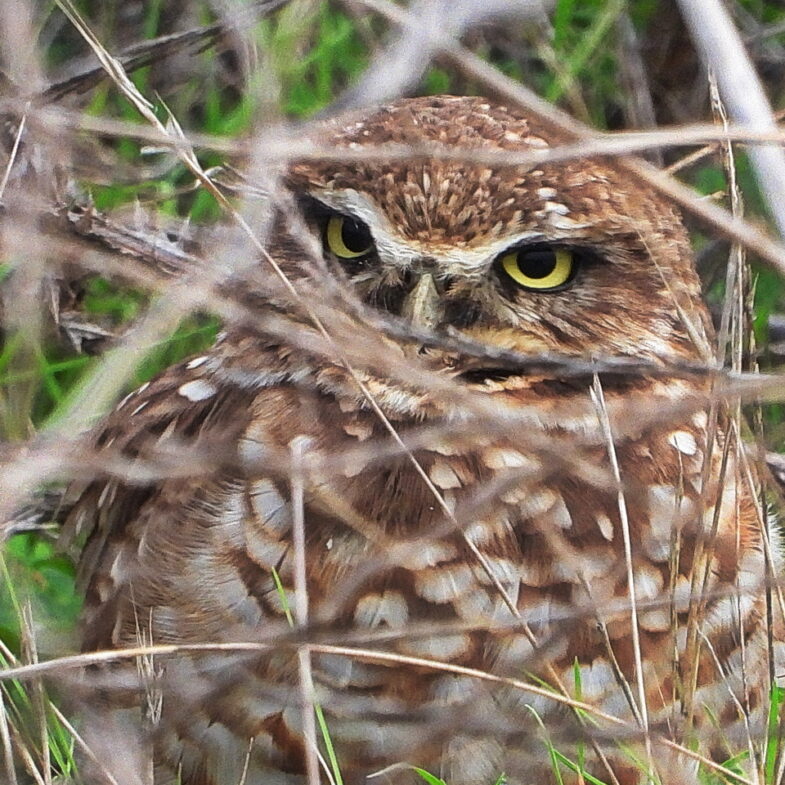
On Nov 14, Erica Rutherford spotted an owl hiding in the dense shrubbery on the slope south of the Spiral, an area labeled Perch C. Named the “Shy Owl” because it chose a heavily screened refuge, this became one of the seasonal resident owls and soon grew a fan club. A long line of park visitors saw and photographed it in the following weeks. It shifted positions a few feet this way and that. Occasionally it was seen briefly on top of the rocks just north of the Spiral at Perch D, and it sometimes took “days off.”

In early January, visitors spotted a second owl in the Perch C area, maybe 15 feet apart. This was almost certainly the original Perch A owl on a visit. On certain days, only the owl on the left was visible. This led to questions whether the owl on the left was the visiting owl while the Shy Owl was hiding out of sight, or whether the second owl was gone and Shy Owl was switching spots between the more visible perch on the left and the densely hidden spot on the right. Then Yvette Bozzini one day saw the Shy Owl emerge from its deep hiding place and stride out to the grassy spot where it was more visible. Mystery solved. The Shy Owl was last spotted on Mar 1. Ignoring occasional days when this owl could not be seen, its residence in our park lasted 107 days.
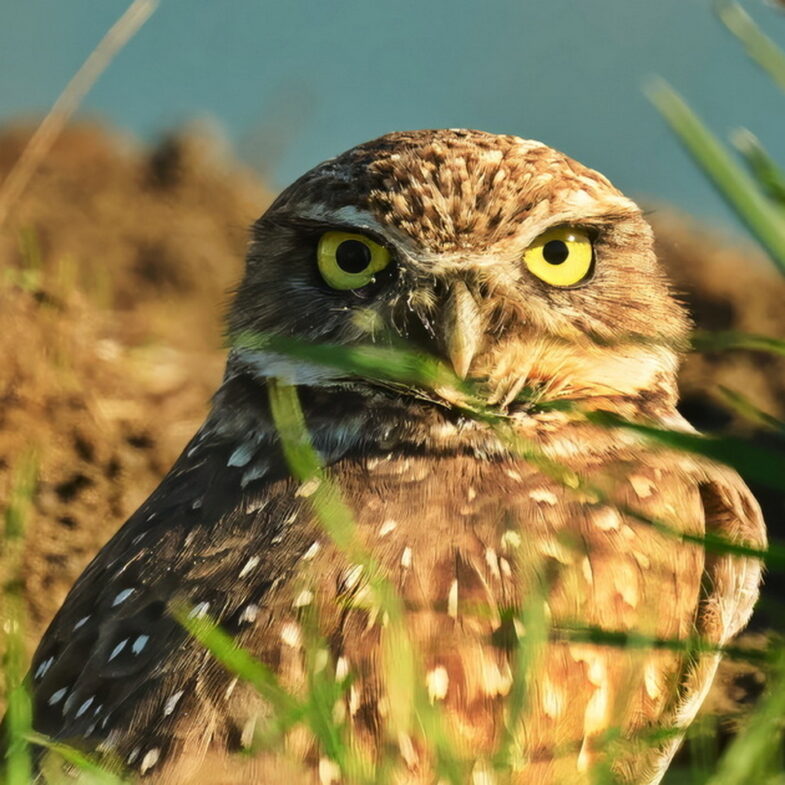
On Nov 21, I spotted a new owl at Perch E. Photos by Keenan Quan showed that this was a new bird. It disappeared until Dec 4, when Mary Law, Feleciana Feller, Roger Herried, and Susan Black each spotted and photographed it at Perch E. Perch E then remained vacant until Jan 13, when Feleciana Feller again spotted an owl there. This bird again disappeared until Jan 27, at which point it settled in. The Perch E owl became a photographer’s favorite, yielding images by Trish Powell, Rick Meyler, Hao Tran, Eildert Beeftink, Amy Faulkner, Harmony Yu, Feleciana Feller, Rick Lewis, Kim Dixon, and Roger Herried, among others. In mid-February this owl moved about two feet south into dense vegetation, where it sometimes hunkered down so low that only a high-zoom lens could spot it, and other times held itself so tall that park visitors were startled to see it. This owl remained in residence longest of all our owls this winter season. It was last seen on Mar 16. If we count Nov 21 as the first day of its residence, it was here – off and on — for 105 days.
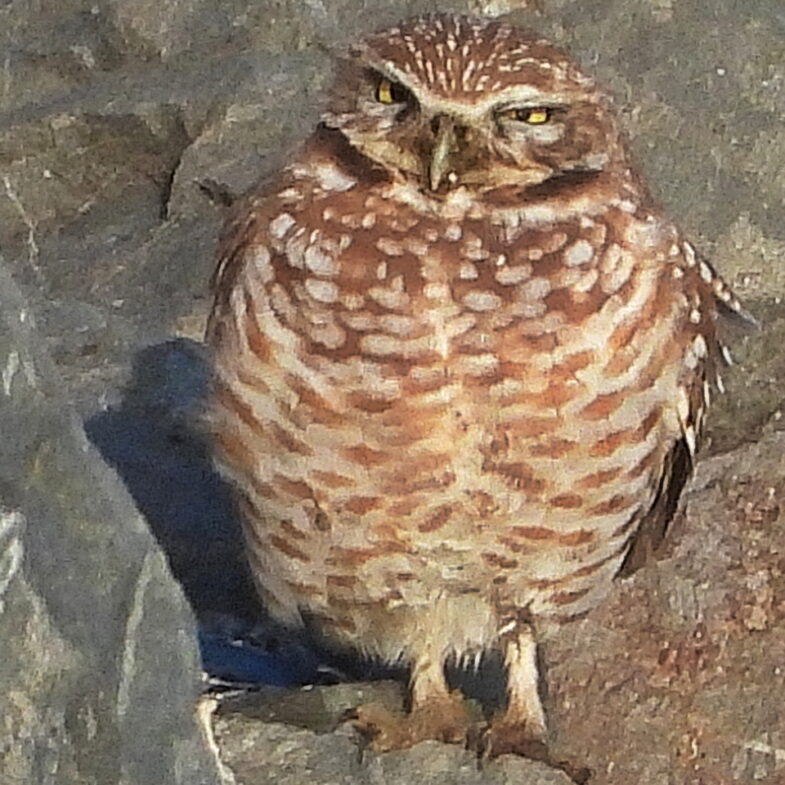
On Nov 29, I spotted an owl at Perch A. This has been a historically popular perch for owls. It’s unclear whether this was an owl returning from a previous year. I saw this owl again at that spot from Dec 13 through Dec 17, and then again on Dec 19 and Dec 23. On Dec 30 and again on Jan 6 the same owl was spotted further south near the Shy Owl at Perch C. Tianxi Zheng, Naomi Schapiro, and Feleciana Feller got photos of both owls within a few feet of one another in the Perch C area. On Jan 7, Jan 9, and Jan 15, Perch A hosted a different owl. An owl that looked like the original Perch A owl was photographed on the north side on Mar 3. At this point, keeping track of the individual owls began to feel like a game of whack-a-mole. Owls kept popping up in unexpected places.
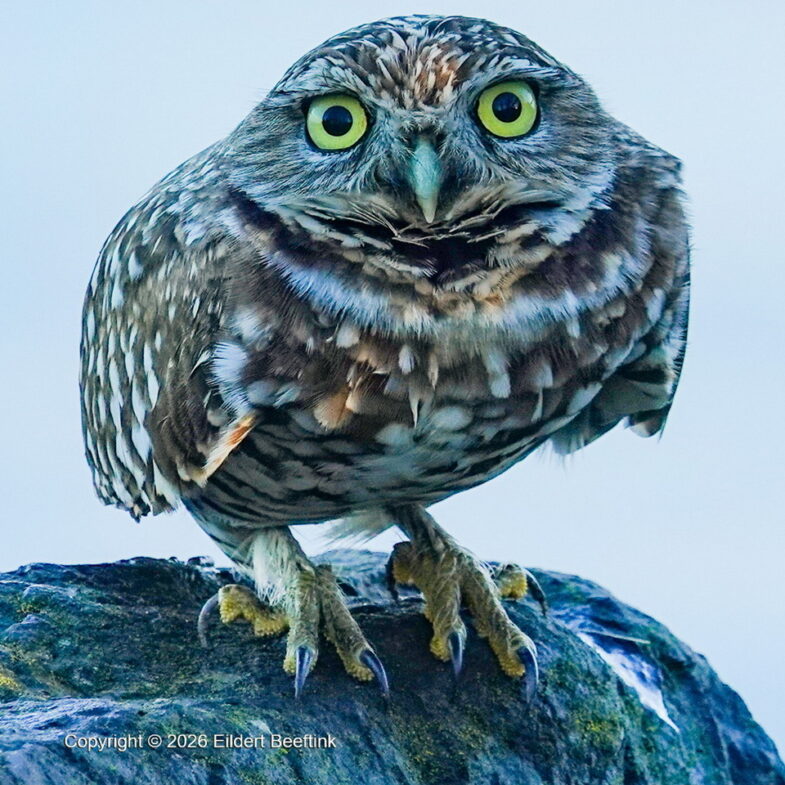
On Jan 5, Hao Tran showed striking photos of an owl at dusk on the north edge of the park, several hundred feet to the west of the Burrowing Owl Sanctuary. At first take, I thought this was one of the already known owls out foraging in the darkness, as they do. But then Debbie Perkins shared a photo she had taken two days earlier of an owl on the north side during daylight. And Eildert Beeftink shared a Jan 5 photo of a north side owl, also during daylight. It became obvious that there was another owl in town. But for a month we had only additional night photos by Hao Tran. Then on Feb 8, Yvette Bozzini caught a cellphone pic of a north side owl, west of the sanctuary, during daylight. That brought Hao Tran out in daytime, and on Feb 13 he shared a series of shots of a Burrowing Owl in daylight on the north side, at a time when the owls at Perch C and Perch E were also clearly visible. There was no longer any doubt that we had a third owl living on the northside riprap hundreds of feet west of the Burrowing Owl Sanctuary. In the following days, other photographers – Cheryl Foster, Mary Law, Feleciana Feller, Lyla Arum, Barry Thornton, Bob Day, Paul Bunk among them –confirmed the finding. This bird became a star for park visitors eager to see a Burrowing Owl. It was observed flying low along the riprap to a number of widely separated spots, so no attempt was made to assign its perch a label. The North Owl was last spotted on Mar 6.

The winter of 2025-2026 was a very good Burrowing Owl season for our time. There were days when park visitors could see no owls, but many more days when at least one owl was present, and a number of days when we had two and even three owls visible in a short walk. Human interest in our Burrowing Owls is keen. Bay Nature magazine featured an article about them, and invited me to give a slide show presentation in February attended by 100 people. Given that these birds are in long-term decline and are now rare and endangered, three owls in residence for the season is reassuring: they’re not altogether gone. Their presence keeps hope alive and fuels efforts to protect and support them.
For the ornithologist, the season was a statistical challenge. We have no way of identifying individual owls without seeing them “full Monty” in good light. Many of the owls showed only fractions of their front plumage. While we can say with some confidence that the same owl occupied Perch C from Nov 14 to Mar 1, we can’t be so sure about Perch E and the north side. Was the owl first seen at Perch E on Nov 21 the same bird as the owls seen there on Dec 4, on Jan 4, on Jan 13, and on Jan 27? Did the North Owl begin its residence on Nov 1, Nov 14, Dec 5, Jan 3, or Feb 8? As for the more transient owls seen at Perches A and B, we can be confident that at least two different owls visited those spots. We have no reliable information about the owl visitor or visitors at Perch F. Summing up, how many different owls did we see here this winter season? Certainly more than three. But how many more? Counting the one-day spottings as separate individuals, it could be more than twelve. Statistically, it’s a headache.
But the scientists’ headache is the park visitor’s joy. We saw “a lot” of owls, considering the desperate times in which we live. Thirty years ago, owls in the park were far more plentiful. I’ve had old-timers tell me that in the northeast corner before the “art” installation was put in, there were so many owls that you had to be careful not to step on one. Habitat destruction has decimated their numbers nationwide.
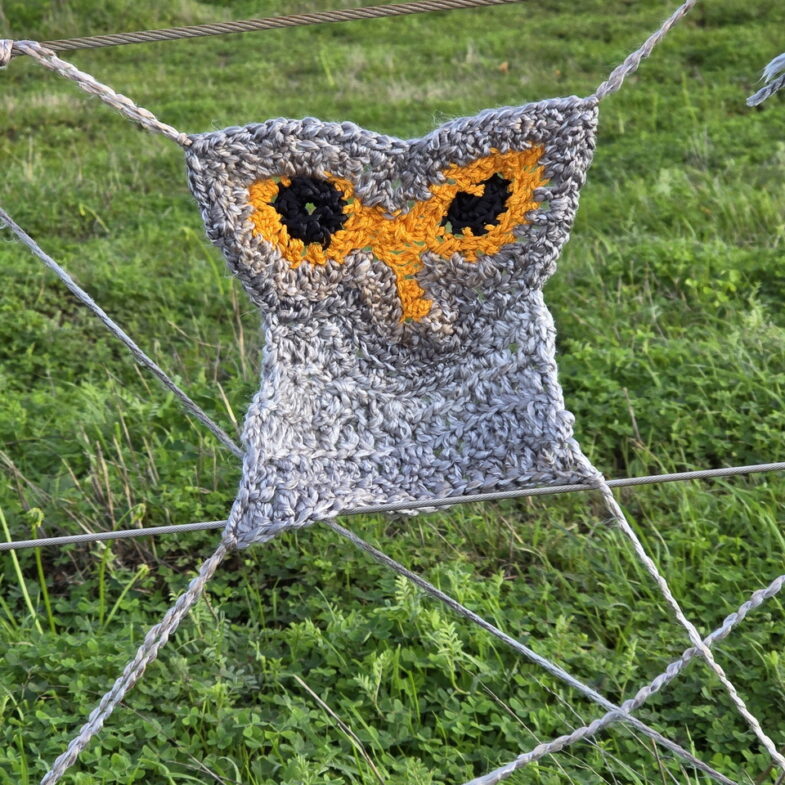
Near the end of the last winter season, we saw two of the resident owls standing wing to wing, like a pair. In terms of climate and food supply, our park would be a good place for Burrowing Owls to stay, breed, and raise chicks. Unfortunately the area is not secure enough to raise a bird family. The “artistic” fence and retaining walls around the seasonal Burrowing Owl Sanctuary are substandard as dog boundaries. The only real art in that fence is the crocheted Burrowing Owls hung there by Carol Denney. Repeatedly this season, as in the past, park visitors observed off-leash dogs, sometimes with no owner in sight, flying over the fence and roaming in the wildlife preserve. No responsible owl parent would try to raise a clutch of defenseless chicks in this field of peril. Berkeley still does not treat its endangered migrant owls with the care and concern that they deserve, and that the law affords them. Your Conservancy has repeatedly lobbied the City to upgrade security in the area. We have even offered to pay for an effective boundary. But our advocacy for the birds has so far fallen on deaf ears.
What did we learn about Burrowing Owls this season? Most of them perched in the Burrowing Owl Sanctuary, but at least one of them stayed outside. Most of them perched very near Ground Squirrel burrows and took refuge underground when threatened. Some, like the owls at Perch A and B and the North Owl, stayed mostly on the riprap, using cavities between the stones for protection. All the owls we saw this season tended to be cautious. It was exceptional to see them standing out full body, easy to see. The “Shy Owl” in particular picked a densely protected perch. Last year, the owl in that same spot was a bit of a show-off, standing out in the open for hours, heedless of risk. This year, owls in highly exposed perches like F, A, and B didn’t stay long. We’re learning once again that the owls have personalities, and that formulas about their behavior need to be framed narrowly.

The 2025-2026 Burrowing Owl winter season is over. It takes a village to track the Burrowing Owls. The ongoing web coverage is a community product, a network where sightings are shared and discussed. This past season, special recognition is due to Lyla Arum, Eildert Beeftink, Susan Black, Daniel Borgstrom, Yvette Bozzini, Virginia Browning, Paul Bunk, Bob Day, Kim Dixon, Carrie Edwards, Amy Faulkner, Feleciana Feller, Cheryl Foster, Jonathan Hall, Roger Herried, Grant Hough, Rachel Katz, Louis Kruk, Mary Law, Rick Lewis, Shizuko McLarty, Rick Meyler, Gail Offen-Brown, Debbie Perkins, Trish Powell, Keenan Quan, Peter Rasmussen, Kathleen Richards, Phil Rowntree, Erica Rutherford, Carolyn S., Naomi Schapiro, Melissa Schneider, Barry Thornton, Hao Tran, Yinhe Wang, Harmony Yu, and Tianxi Zheng. Many park visitors may now forget about owls. But for the band of dedicated owl watchers, our eyes are on October.
Oh, and while you can’t see real owls for a while, there’s always the “Our Owls” book – more than 100 Burrowing Owl photos by more than a dozen photographers taken right here in our park. And you could go wild and read the new dystopian fantasy novel featuring our Burrowing Owls as heroes: Birds and the Emperor.
Publishing Schedule

This blog drops whenever there’s material and motivation, and not on a regular clockwork schedule. To avoid FOMO, subscribe.


Thank you SO much for the updates and photos and hopeful information. I remember seeing so many Owls along the shoreline there years ago, like you said, before the $100000 “art” waste that is no protection at all. There actually needs to be no dogs allowed since there is no way to protect the leash area and almost every other park is full of dogs. Not to mention the dog owners encouraging their dogs in the leash area to attack and kill the Ground Squirrels. For all of our safety, we should have one park without dogs, but especially for the precious little Owls.
Thank you for all you are doing for that little park.
Sorry, I didn’t see any “edit” feature. I’m looking forward to READING your novel. (It arrives tomorrow.).
Great illustrated summary/history of the Burrowing Owl sightings. Looking forward to read your novel!