
Park News 6/12/2025
“Soil Disturbance” a Raid on Park Dollars
Last night’s meeting of the Parks Recreation and Waterfront Commission revealed disarray in the city’s waterfront management. Based on the City Manager’s bizarre June 5 “soil disturbance” memo, the city will “reprogram” the $1.7M in State money that was to have renewed the paved perimeter trail around the park, according to Deputy Parks Director Christina Erickson. The new restroom project is supposed to be relocated across Spinnaker Way, but is on pause for redesign. A proposal for parking fees is being forwarded to city council before information on administrative expenses has been obtained. And the proposed Conceptual Plan for Chavez Park is dead, along with the whole Waterfront Specific Plan process. Finally, nobody present, staff or commissioners, had any information on plans for the dead whale anchored in the North Basin for the past two weeks.
Both of the principals usually seen at these meetings were absent last night. Parks director Scott Ferris’ usual reports were delivered by Erickson. Allan Abshez, commission chair, skipped the meeting after his pet project, the Conceptual Plan, was deep-sixed.
City Manager Paul Buddenhagen’s June 5 memo claimed that a new consulting firm, Geosyntec, had issued a “Health and Safety Plan” that required an end to “significant disturbance of the surface soils” at the park because this “could breach the landfill cap.” This is hard to believe because the cap over the landfill is at least six feet thick and in hilly portions may exceed 30 feet. The CM’s memo did not attach a copy of the Health and Safety Plan. The Parks Department met my public records request with a stalling message, claiming the records were voluminous and required an extension of time to answer. Translation: they don’t want the public to see it.
The restroom project underwent an extensive soil analysis in August 2024. The Haley-Aldrich soil engineering firm commissioned two soil bores at the site. Both bores found sand and clay to a depth of at least ten feet. See the full report here. There is no basis for a claim that superficial soil disturbance will breach the landfill cap at this location. The decision to move the restroom project out of the park and across the street appears to be a stalling maneuver that is liable to snuff out the project entirely and “reprogram” the money elsewhere.
Similarly, the CM’s claim that resurfacing the perimeter trail would risk breaching the landfill cap lacks credibility. Most of the perimeter trail runs on the original stone levy that surrounds the landfill, and not on the fill itself. Even on the far north side, where the cap over the fill may be as thin as four feet in places, a repaving job on the fill would scrape only a few inches and poses no danger of breaching the cap.
The process of unspecified “further testing” to determine the danger of soil disturbance in the park is expected to take from two to three years, according to the CM. No explanation is offered why it would take this long. The radiation survey conducted by the UC Berkeley Rad Lab took three days and then the Surface Emissions Monitoring survey conducted by the Sniffer Robotics firm took one day. If no weeds can be pulled for three years, there will be a re-infestation of French Broom (Genista monspessulana) and other invasives. As Susan Schwartz, president of the Friends of Five Creeks organization, pointed out from the floor at the meeting, she and other volunteers spent years pulling these invasives out of Chavez Park soils. New sprouts appear regularly on the north side every spring season.
The “soil disturbance” ban does not directly impact the stewardship work of the Chavez Park Conservancy in the Native Plant Area, Restoration Coordinator Bob Huttar pointed out. “We have told the City that we understand and will comply with this request,” Bob wrote. Volunteers are not barred from weeding and watering, and can cut the weeds at ground level. “We may not always be successful but we will give that plant a very bad day.” At this time the Conservancy does not have plans for plantings additional to the 225 seedlings we put in the ground during the past three years to create the Pollinator Garden, Bob said.
The CM’s memo also pins a target on Ground Squirrels, whose burrows allegedly breach the landfill cap. This ignores research showing that California Ground Squirrels do not burrow in clay soils. As park visitor Virginia Browning pointed out from the floor at the commission meeting, if it is believed that the squirrels are burrowing in radioactive materials, it would be an easy matter to capture a few and test them for radioactivity. Methane sniffer devices have also passed over the mouths of squirrel burrows countless times without detecting methane. Ground squirrels are not villains here. They are also a widely beloved species. A decade ago, when the Water Board proposed to eradicate them on unsubstantiated suspicions that they were leaking pollution into the Bay, the city was inundated with 40,000 emails defending the squirrels.
Equally baseless was the accusation, launched by a commission member, that Black-tailed Jackrabbits were digging deep burrows in the Off-Leash Dog area. This is a mistake. Black-tailed Jackrabbits (Lepus californicus) do not dig burrows at all. Despite their common name, they are hares, not rabbits. They live and give birth in shallow depressions called forms, and may occasionally hide in burrows dug by other species for temporary shelter. Source 1, Source 2. They do not dig.
On the parking issue, the city showed little credibility. A city memo claimed that charging for parking would raise around $180k. But Erickson’s narrative said that the city had only just begun to contact the Public Works department, which oversees parking meters throughout the city, about the mechanics of setup, administration, and enforcement. Several speakers pointed out that the $180k figure was picked out of thin air, and that fee parking operations in other situations showed little if any net gain over administrative costs. It was clear that parking fees would act as gatekeepers to keep lower income families away from the waterfront. Jim McGrath, former commission chair, argued from the floor that this was contrary to basic equity and to the public trust under which the State granted the waterfront lands to the city. Although comment both from commissioners and the public was sharply negative on the fee parking idea, the Commission passed a bland and verbose resolution that will have little impact at city council.
In a lengthy new memo distributed at the meeting, the CM joined by Ferris killed the Chavez Park Conceptual Plan proposal authored and shepherded by commission chair Allan Abshez. As reported here on June 8, Abshez’ plan called for city council members Rashi Kesarwani and Terry Taplin (neither of whom has expressed notable interest in the park) to appoint members to a “Revisioning Team.” This would do various visits and hold a series of meetings and other processes resulting in a recommendation to city council for work on Chavez Park. The CM opined that the process would take longer than a year and would cost more than the $200K that Abshez foresaw. The $200k would be better spent elsewhere. The whole Waterfront Specific Plan (WSP) is now on indefinite suspension “until full funding has been identified.” RIP WSP.
The WSP and related issues have been moved from the June 17 city council calendar to the June 24 meeting, according to Roger Miller, Parks commission secretary.
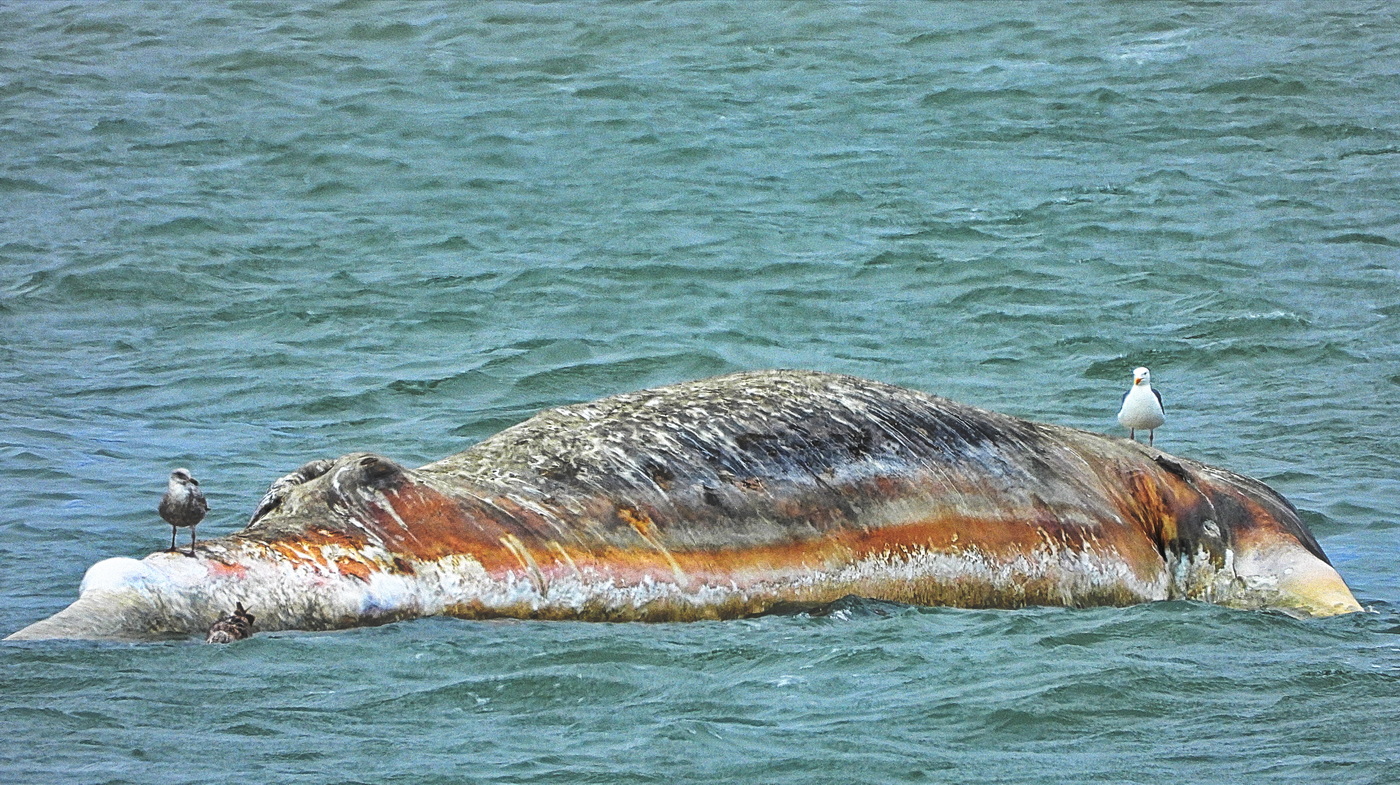
No one at the meeting, including Parks staff and commissioners, had any information about plans for the dead Gray Whale that has been anchored in the North Basin for the past two weeks. As one park visitor told me, the plan seems to be R.I.P. — Rot in Place. The carcass looks somewhat swollen from internal gases of decomposition. The gases sometimes cause whale carcasses to explode. Meanwhile the only scavengers are gulls, which may have found a weakness in the whale’s thick hide in the partially submerged tail portion. The carcass is becoming a point of interest for park visitors from all over.
One Special Bird
So much politics, so little bandwidth left for nature. It’s been a quiet bird period. But ace photographer Eildert Beeftink captured a prize, a picture of a Black Skimmer in the air. Black Skimmers (Rynchops niger) were first reported here on Dec. 31 last year, but the only available photo was a cell phone snapshot from a distance. To show what the bird looked like I had to copy an archive image from Wikipedia, which I hate to do. Now here’s a good photo from a local hand:
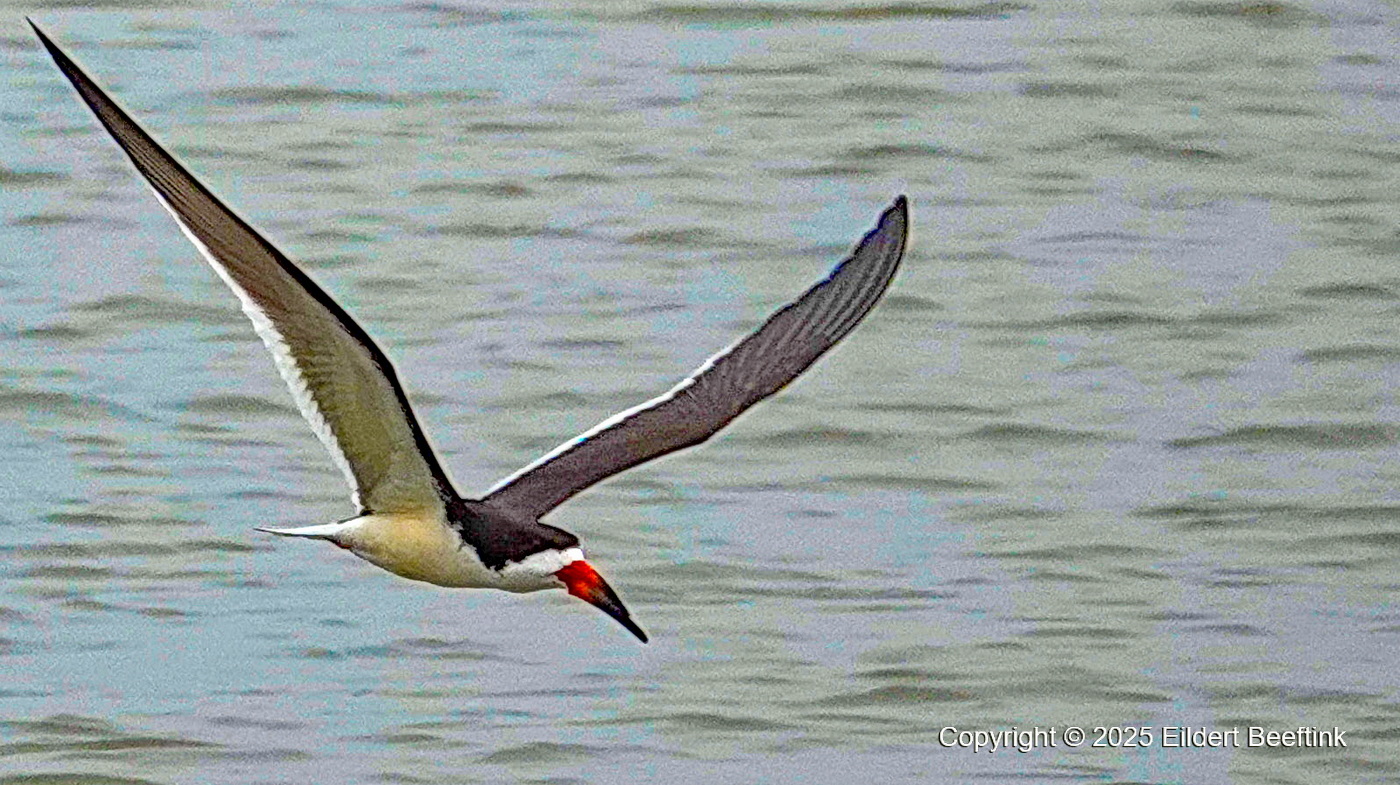
These birds have an amazing foraging method. Using their ample wings for stability, they glide over the water with their open bill slicing the surface. When their lower mandible encounters a little fish, the top of the bill snaps shut instantly, capturing the prey. They can even do it in darkness. No other bird does this. They have been seen here and further north off the Richmond coast for several months. I hope one day to get a photo of them in operation, maybe with a fish in beak. Congratulations and thanks to Eildert for snapping this fast-moving bird in flight.
Publishing Schedule

This blog drops whenever there’s material and motivation, and not on a regular clockwork schedule. To avoid FOMO, subscribe.
. .


Thank you, Marty, for the good reporting of the Wednesday meeting which I wish I had attended.
Very thorough reporting, your time, effort and energy, greatly appreciated, since it’s the only informative source of information.
Meanwhile, 199 Seawall Drive, Hs. Lordship’s, continues to deteriorate, given its exposure to all types of weather conditions and virtually zero maintenance, while the City apparently spends $20,000 a month to maintain, under a false assumption that an outside restaurant corporation will lease.
Overall, the City should appoint a “mayor” of the entire Berkeley Marina and Cesar Chavez Park – keep the Harbor Master, but a new fresh approach; someone who actually walks all areas Saturdays and Sundays, who rather than handing out parking citations, hands out thank you cards.