
Park News 8/23/2025
Today: Burrowing Owl Book is Out
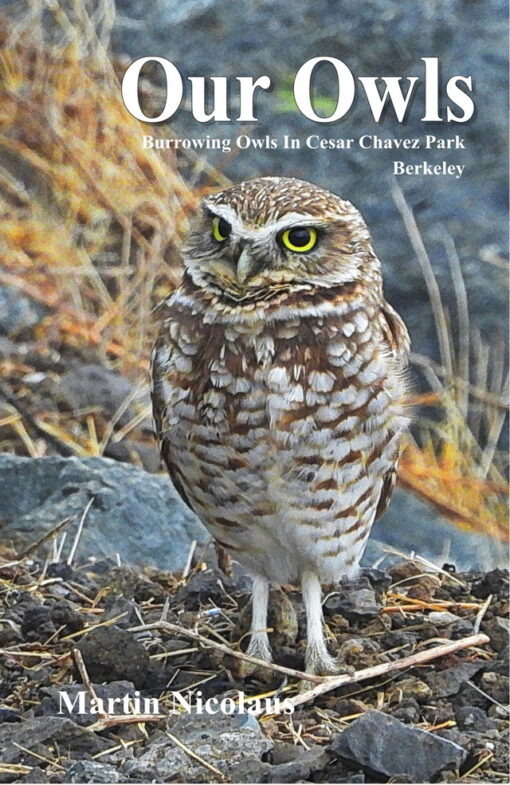
The first and only book dedicated to the Burrowing Owls in Cesar Chavez Park is out today in online and paperback editions. A hardcover edition came out Aug 24.
The book features more than 100 full-color pictures contributed by more than a dozen photographers. It includes owls seen earlier this year as well as owls from past years as far back as 2018.
There’s photos of owls showing off in easy view, and of other owls in deep hiding and hard to see. There’s information on where and when you’re most likely to spot one.
You’ll learn what they eat and when they sleep. You’ll see them yawn and nap. Photos show them stretching and twisting to scratch and preen. What do you think they do when it rains? A series of photos may surprise you.
There’s a chapter with lots of photos showing their friendship with California Ground Squirrels. Another chapter shows the dangers they face in the park.
The final chapter puts our owls in a broader perspective, shows what their relatives in Florida and in South America have achieved. The book holds out the goal of creating conditions that will persuade our owls to stay for the summer, build nests, and hatch Burrowing Owl chicks.
The tone of the book is conversational, aimed at a general audience, but it’s backed up by the scholarly literature. There’s an appendix with a map, statistics, translations, and footnotes. The photos are full color on semi-glossy paper. The text is in a moderate size, easy to read.
Chavez Park is a unique place for Burrowing Owls. There’s very few spots on the West Coast where you have the chance of seeing one of these rare and endangered birds, or maybe even two or three, in an afternoon’s walk in the park. If you love Burrowing Owls and want to know more about them, you’ll love the “Our Owls” book. It’s also a great way to share your love of the owls with others.
Proceeds from sale of the book will benefit the Chavez Park Conservancy. Online ebook. Paperback.
Monday: Protect National Parks

A gathering to protect national parks will take place in front of the Rosie the Riveter National Museum in Richmond this Monday Aug. 25 from 11 am to 12:30. The event will raise awareness of recent efforts to defund national parks, censor history and erase inclusive narratives from public interpretation. Speakers include • Jon Jarvis, 18th Director of the National Park Service (2009–2017) • Neal Desai, Pacific Region Director, National Parks Conservation Association • Donna Graves, historian who helped found Rosie the Riveter/WWII Home Front National Historical Park • Doria Robinson, founder of Urban Tilth and community leader • Flora Ninomiya, whose Japanese American family was forcibly removed from their Richmond home and cut-flower nursery to a WWII incarceration camp • Elena Gross, Director of Exhibitions & Public Programs, GLBT Historical Society
Activities will include: • Story-Gathering Station – Record short videos on why national parks matter • Community Art & Activism – Sign a giant “Happy Birthday NPS & Happy 25th Anniversary Rosie” card, create origami cranes with Tsuru for Solidarity as symbols to “Stop Repeating History,” and chalk supportive messages on the sidewalk • Photo Opportunities – Hold large letters spelling “Support Our Parks.” This event is supported by Indivisible East Bay, Contra Costa Japanese American Citizens League, Tsuru for Solidarity, and by National Parks Conservation Association. Thanks to Berkeley Historical Society for forwarding the information.
Wednesday: Pollinator Garden Stewardship
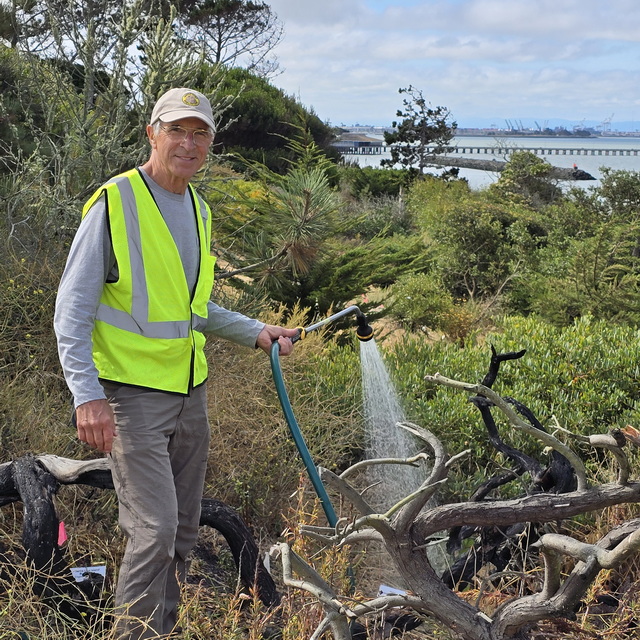
Bob Huttar, Chavez Park Conservancy Restoration Coordinator, writes:
I hope everyone is having a good summer. We are having a Chavez Park Pollinator Gardens stewardship next Wednesday where we will be weeding and watering. There are several plants, especially in the Meadow area near the storage bin, that have been overlooked, mostly because they are hidden by weeds now and need to be freed from the clutches of those nasty invaders. The moratorium on any soil disturbances is still in effect so we cannot pull the weeds up. Instead we need to clip them as close to the ground as possible.
We will meet at 9:00 in the usual place near the storage bins north of the parking circle at the west end of Spinnaker Way and work until lunchtime or so. Let me know if you have any questions.
Sep 14: Conservancy at Solano Stroll
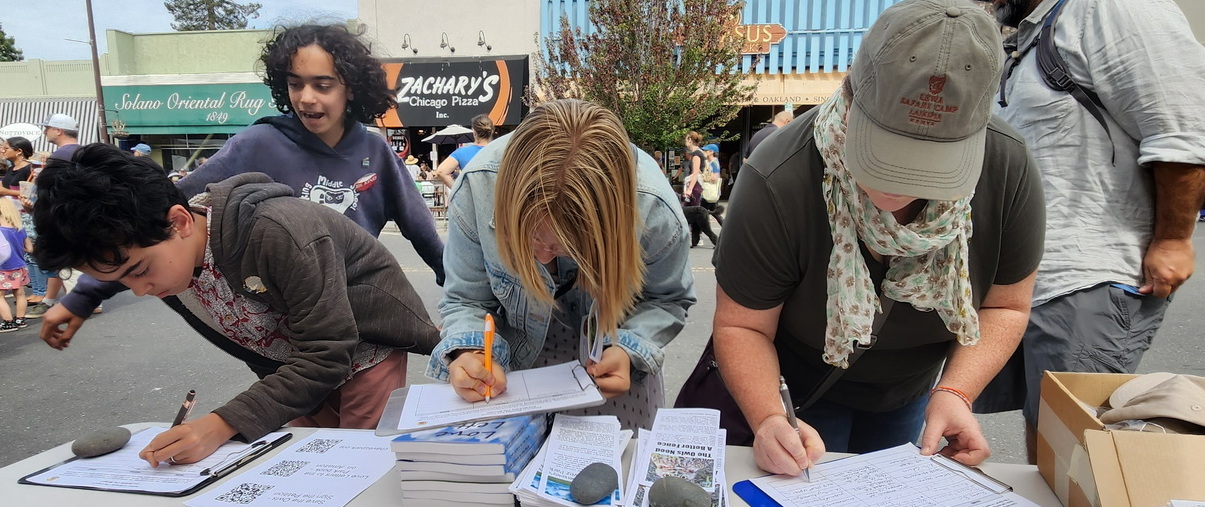
The annual Solano Stroll is happening Sunday Sep 14 this year, and the Chavez Park Conservancy will be there. Look for our stand on Solano between the cross streets Ensenada to the north and Tulare to the south. We’re in front of the professional offices at 1722 Solano Ave, on the east side, sandwiched between the Aesthetic Pruners Association and the Oakland Hebrew Day School, across from the Alta-Bates Summit tent. We owe thanks to Lee Tempkin for the loan of one of his summer camp’s shade tents. We’ll need volunteers to staff our tables, and for morning setup and afternoon teardown. Please sign up on this form.
We last had a table at the Solano Stroll in 2022. It was an exhilarating experience. While there were moments of quiet, there was a constant stream of people passing by, with instances of jammed crowds at our table. It’s estimated that some 100,000 people do the stroll each year.
Feathers, Flowers, Fur
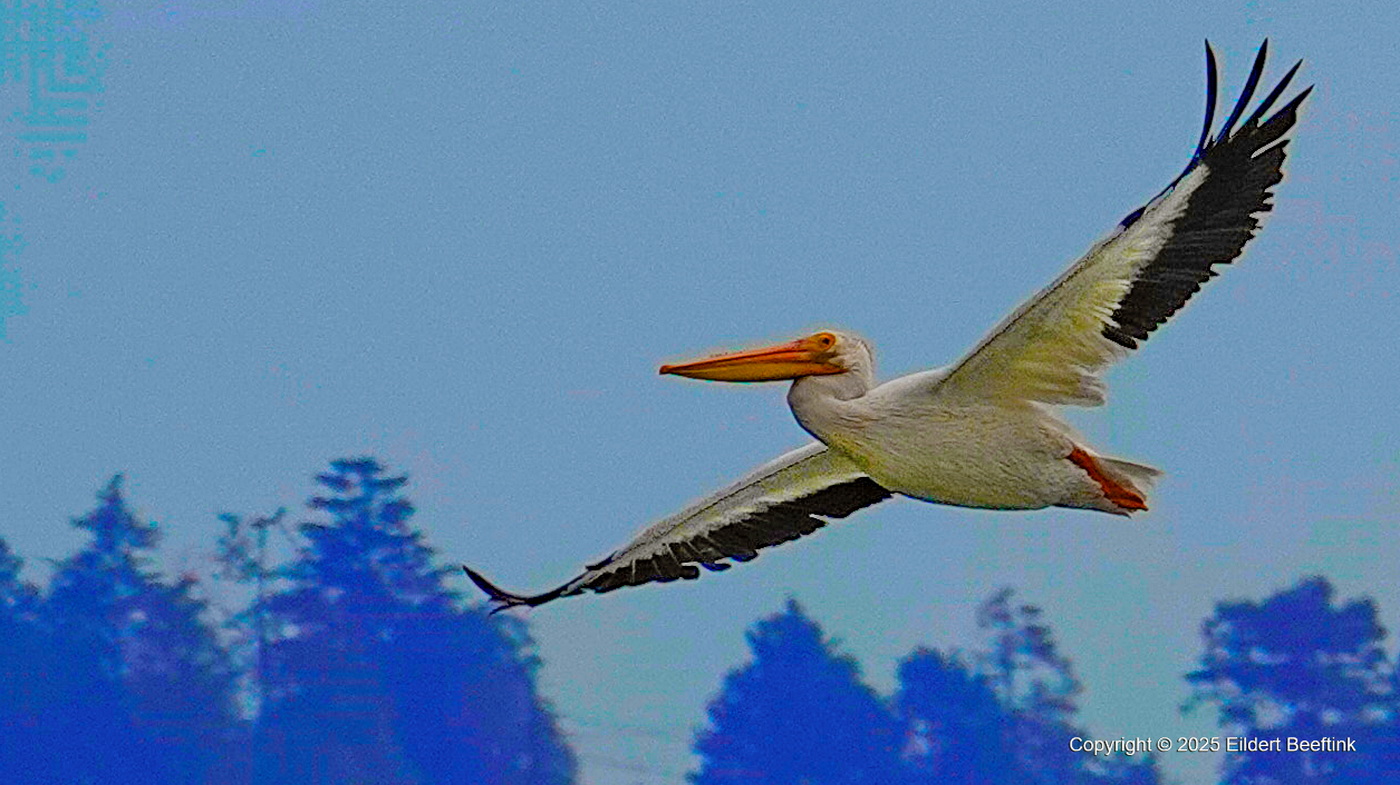
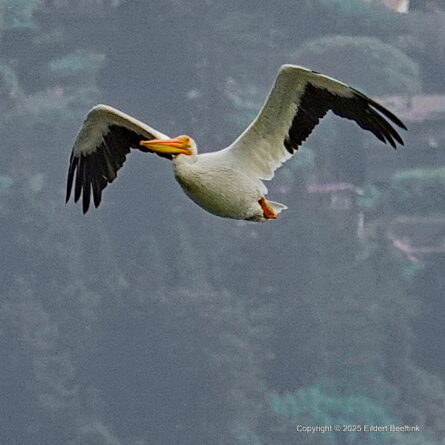
A small flock of American White Pelicans visited the North Basin on August 12, and ace photographer Eildert Beeftink was on the scene and captured this fabulous image. These are majestic birds, with wing spans of eight to ten feet. They are known for cooperative foraging, making a semicircle to drive fish to shallow water where they can be more easily scooped up in the birds’ giant bills. Eildert also got two other photos of these birds in flight:
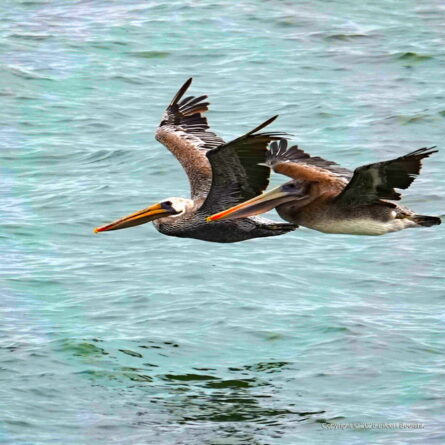
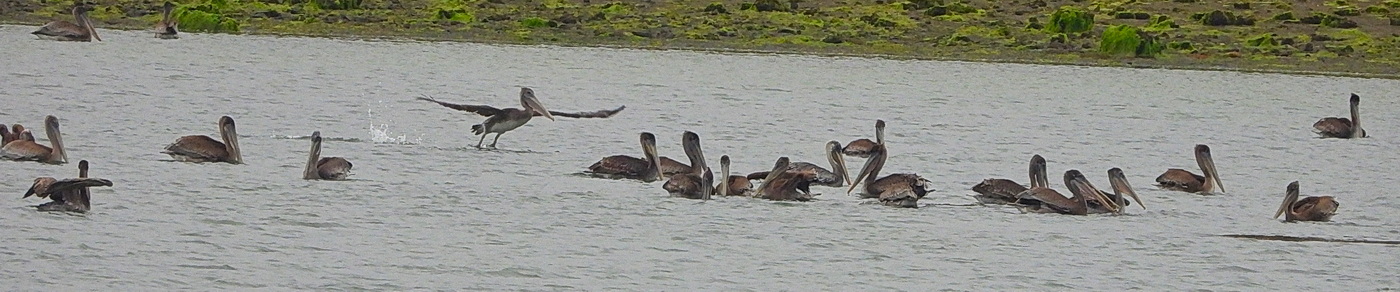
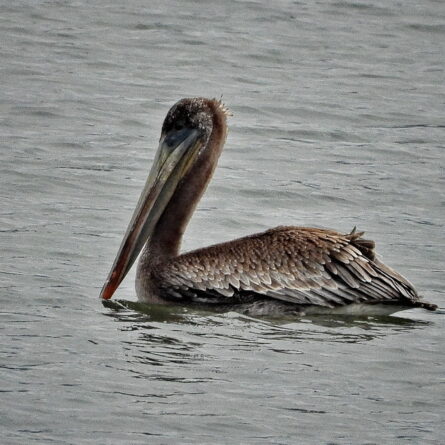
The more familiar Brown Pelicans were out in force this past week, early in the morning. On Friday I arrived at 7:30 just as well more than a hundred of them were in the air heading west. A small remnant was still on the water very near the east shore of the North Basin.

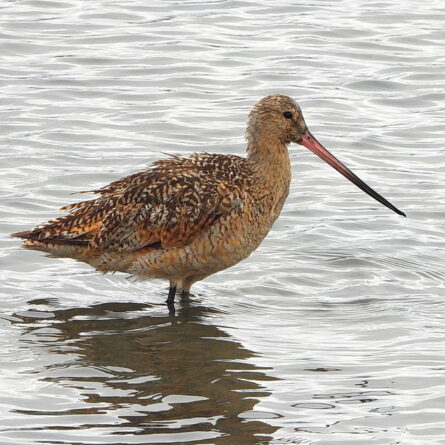
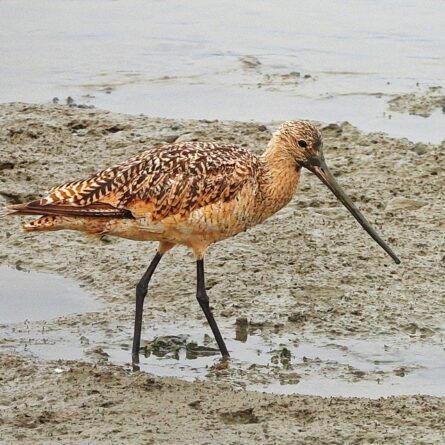
Not usually seen this time of year was a lone Marbled Godwit. This bird was either an unusually early migrant, or a timely migrant several hundred miles west of its main flock. I photographed this individual on Aug 12 and again on Aug 22, so it wasn’t just passing through. Judging by the great length of its beak, this is probably a female.
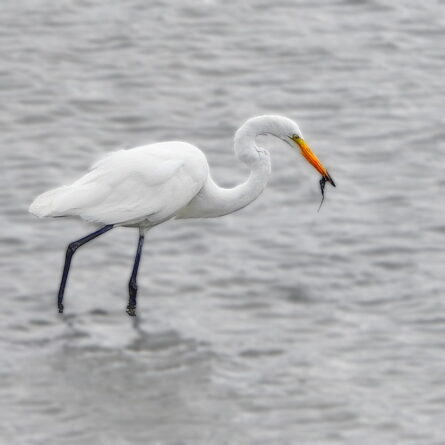
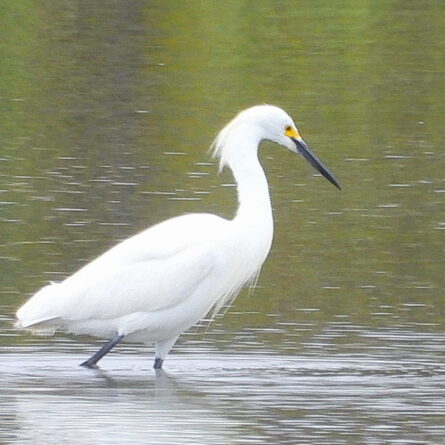
Also on this eastside estuary were a lone Great Egret and, not far away, a couple of Snowy Egrets.

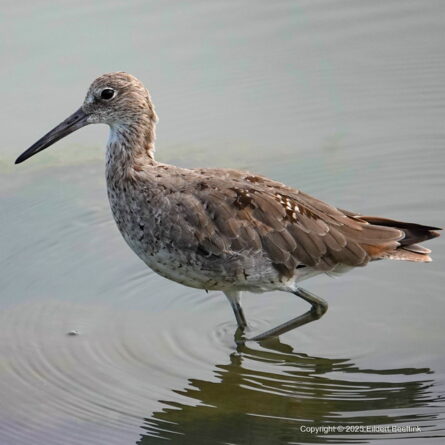
The Cornell Bird Lab maps say that Willets don’t breed here, but sometimes it seems that they do. At least two of them were stalking the water’s edge on the east side of the park this past week, and one of them still had some of its rusty, patchy breeding plumage. The other was all in winter grey. It’s probably safer to say that these are early migrants.

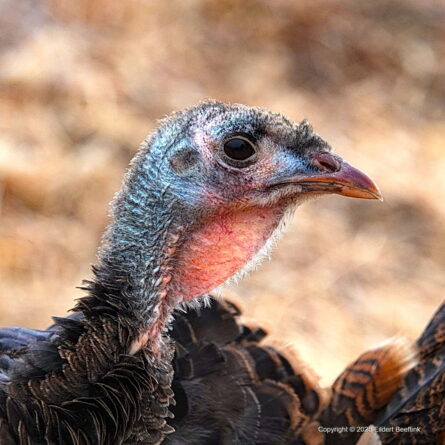
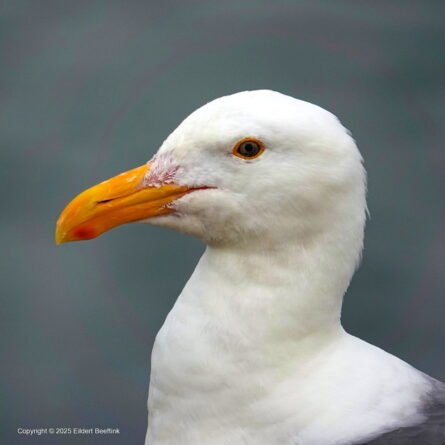
Closeup photos of birds’ heads, like headshots of human personalities, give us a chance to get acquainted with them almost as if they were people. Odd-looking people to be sure, but there’s plenty of odd-looking people around.
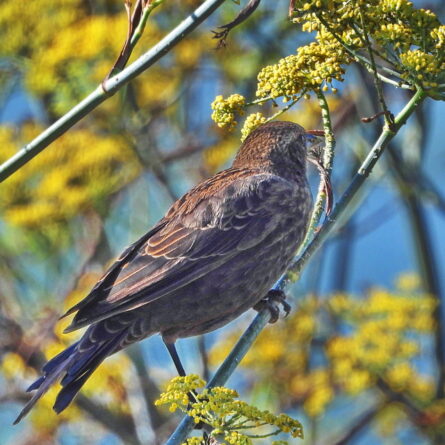
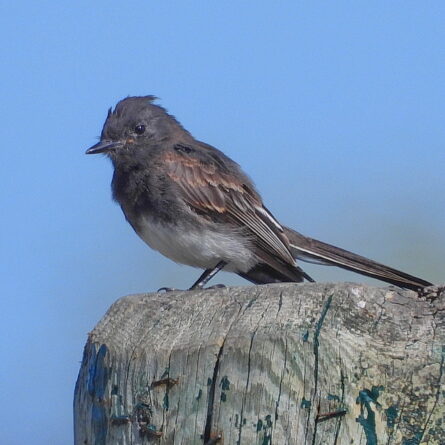
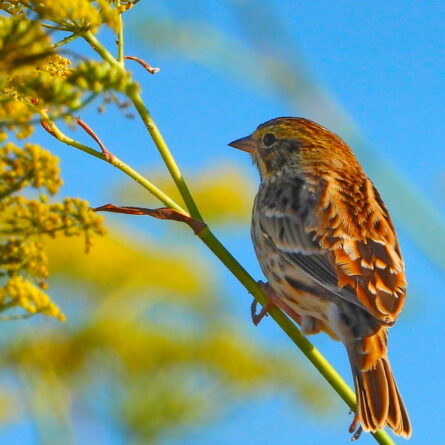
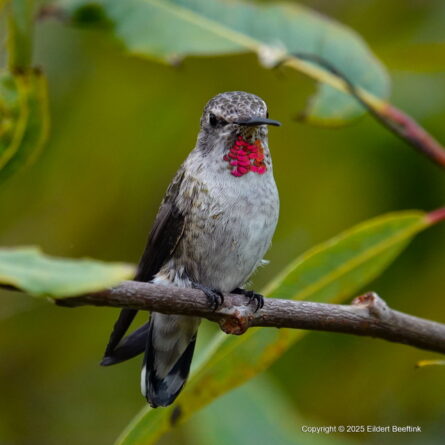
Among the songbirds, I and the Merlin app heard a lot of House Finches and several Song Sparrows and at least one Savannah Sparrow. Eildert captured a beautiful Anna’s Humming bird with part of its gorget ablaze. My camera saw only the finches, plus a Black Phoebe, a White-crowned Sparrow, and what’s probably a Brown-headed Cowbird female picking bugs in the Fennel.


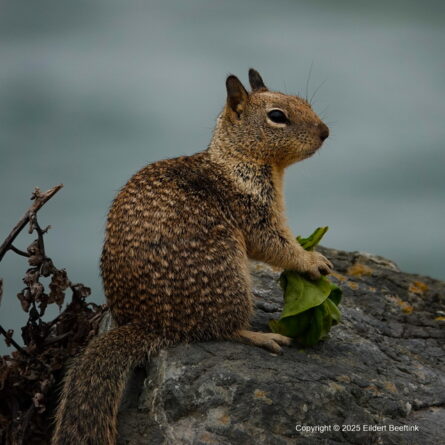
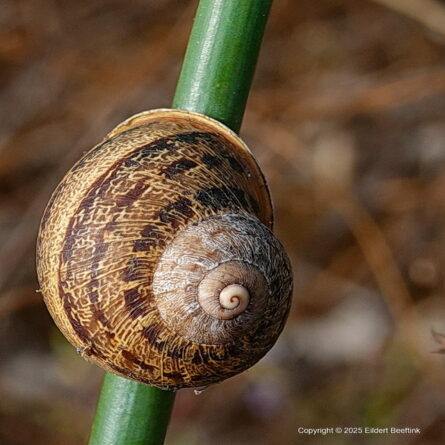
This California Ground Squirrel pup held still for its portrait, showing off the handsome light speckles on its furry coat. The young ones tend to be rather skittish, more so than their experienced elders, and it’s often a challenge to get them to hold still long enough for the camera to frame and focus. Much more cooperative is the garden snail, shown here having a rest on its way up a Fennel stalk.
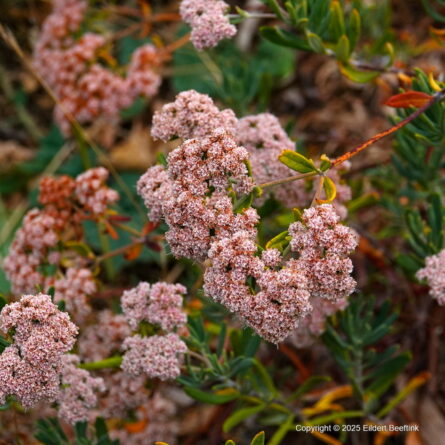
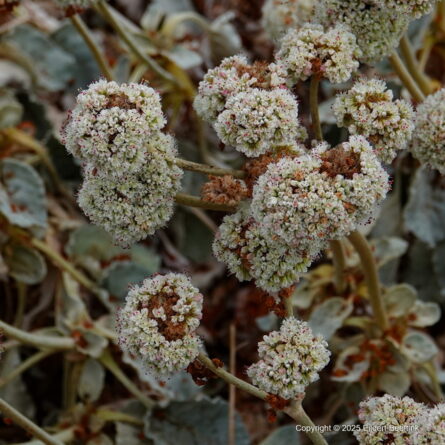
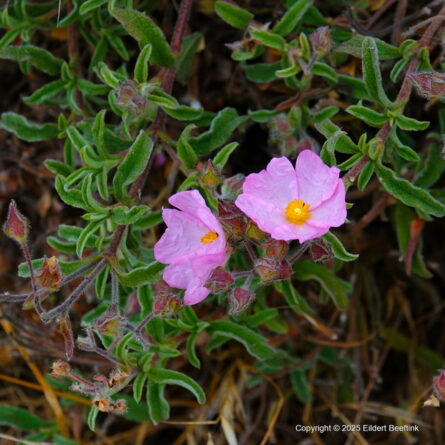
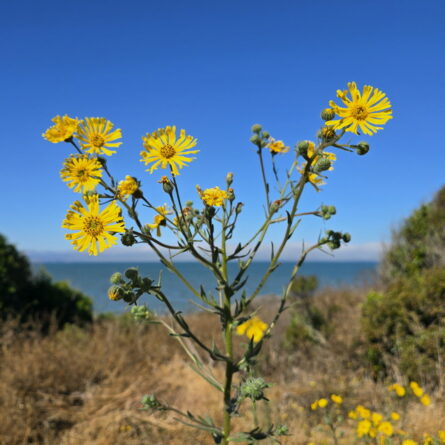
On the botanical side, we have three different California native buckwheats in flower: the Santa Cruz Island Buckwheat, the Coast Buckwheat, and the just plain California Buckwheat. Also blooming is the showy Common Madia. All were planted by Chavez Park Conservancy volunteers as part of the Native Pollinator Garden over the past three years. Also blooming now is a lovely Rock Rose growing on the North side where others planted it years earlier. It’s a Mediterranean import. All over Berkeley, the Naked Ladies are blooming now. Someone years ago planted a handful of them in the Native Plant Area. They don’t belong there (they’re native to South Africa) but we gave them a pass.


Welcome Salty Susan
On the water side of the little land island west of the Native Plant Area, between the paved path and the shoreline dirt trail, part of the the slope is dense with a plant that somehow got overlooked in our previous botanical surveys.
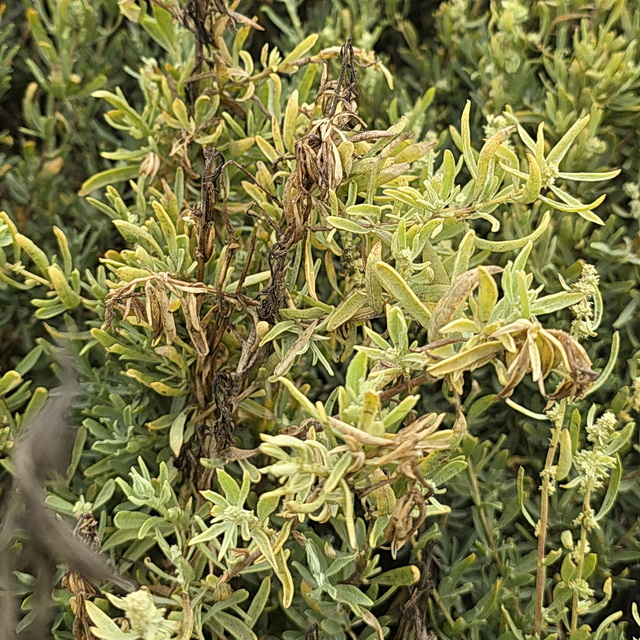
The plant looks sort of like an iceplant, with thick succulent stems. But it’s a different genus altogether. It’s a California (and generally Western states) native called Jaumea carnosa, commonly known as Marsh Jaumea, Fleshy Jaumea, Saltmarsh Daisy, or Salty Susan.
It loves the salty coast, thriving in the spray, and it can live in saltwater marshes. This puts it in a very small minority of plants that tolerate salt, known as halophytes. It doesn’t actually love salt. It will grow very well in a garden served by fresh water. Its advantage is that it can thrive in a habitat too salty for others. It manages somehow to desalinate the water, storing the salt away in special pockets (vacuoles) in its cells, and using the fresh water for its life needs. How halophytic plants achieve desalination is apparently not well understood, according to an extensive research article. Standard industrial desalination relies on high heat or high pressure, not available in botanicals.
Jaumea is a perennial and spreads via underground rhizomes. The dense web of these fibers helps stabilize shoreline soils. In spring it blossoms with small daisy-like yellow flowers that attract butterflies and other pollinator insects.
Its name comes from Jean Henri Jaume Saint-Hilaire, a French botanist and artist who lived between 1772 and 1845. In French, the plant would be pronounced “zhom-a.” In English, the common usage is “Jaw-me-a.” The best online writeup on the plant is here: https://naturecollective.org/plant-guide/details/salty-susan/
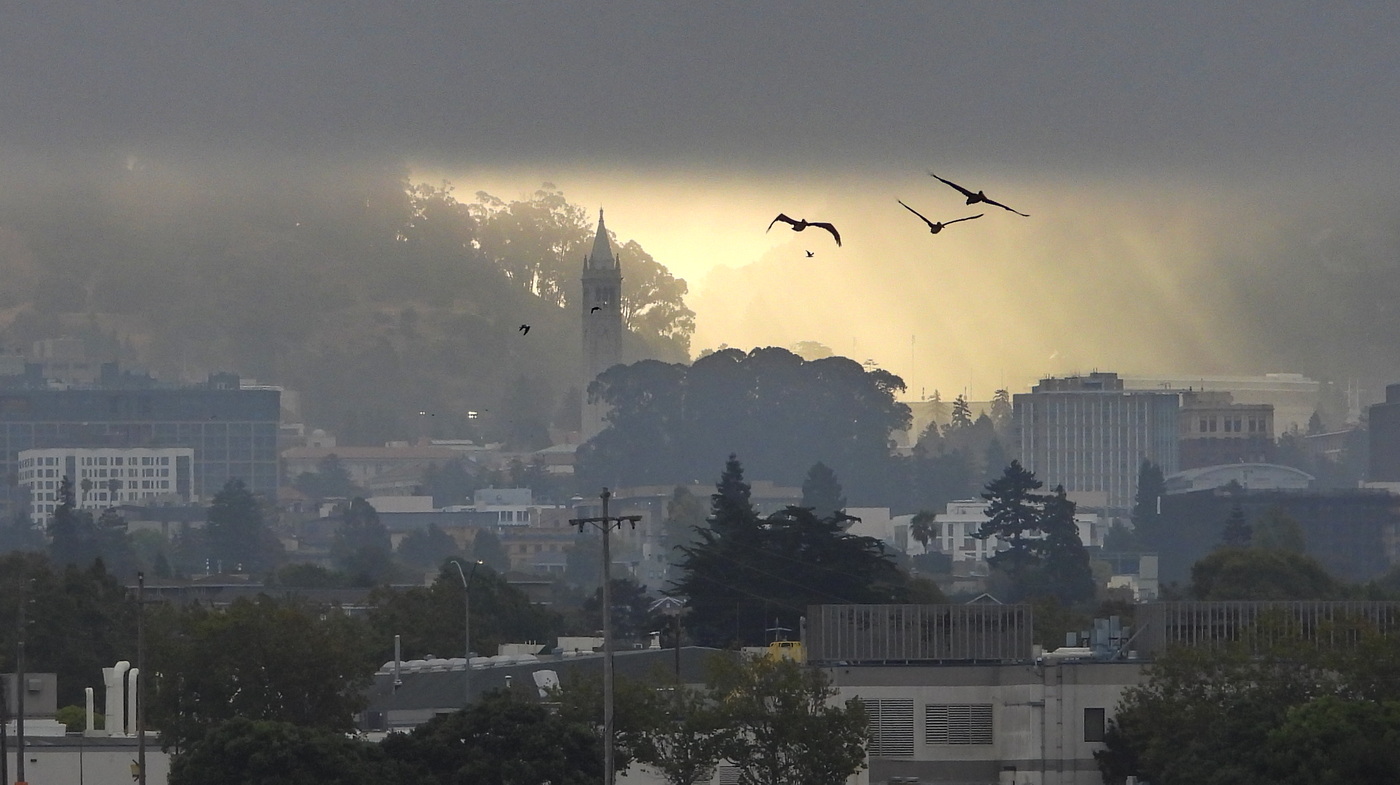
Moody Morning
Publishing Schedule

This blog drops whenever there’s material and motivation, and not on a regular clockwork schedule. To avoid FOMO, subscribe.
. .


Kit: Thirteen posts on this blog refer to the turkeys; go here: https://chavezpark.org/category/birds/wild-turkey/ And yes, sometimes they have come into the park.
Congratulations, Martin! I can’t wait to get my copy.
Have you written about the turkeys? If so, I’ve missed it, but I’m curious as to how they’ve arrived in such numbers. Perhaps none of the dozens of them come onto the park itself, preferring the southern side of the Marina?
Thank you so much.